

Springtime Sadness
Tips for managing springtime depression

Season 20, Episode 04: Springtime Sadness
10 April 2026 – Why my depression gets worse in the spring, and how opening my windows seems to help (plus a few other tips).

This morning, I did my laundry at 7:30 a.m., then buckled down to finally write out this essay. Most of my mornings go similarly: I wake up early, I do work for the day, and then I jump into my required meetings and courses. It sounds productive. It feels productive. But something isn’t quite right.
In my mind there always lingers the procrastination that’s brought me to the work I’m last-minute completing.
This essay, for example, has been haunting my week, yet I only sat down to collect my ideas last night. I scrolled through my note of potential articles, and I felt nothing. I was stuck without a cause. In theory, this week’s article should’ve been easy.
The only reason I’m able to write this now is because my weekly Friday deadlines are driving me, and I have to be done by a certain time. Still, I’m repeatedly distracted.
It’s springtime. I’m supposed to become more productive, happier, lighter. Instead, I’m utterly and inexplicably paused.
For me, it seems my depression grows in the spring as opposed to the winter. I distract myself with routines that I can boast about to others, but under the surface I’m drained. Constantly tired. I feel like a cat curled up in a sunny windowsill––serene and gorgeous, but ultimately purposeless.

Spring doesn’t help itself with its constant twists and turns in weather or its many changes that bring allergies and sickness.
I’ve found myself huddled up in my room the past week, taking naps instead of being active as I was during the winter. Even when it’s warm, I feel overwhelmed by the fact that I should be spending my time outside, but that I also should be spending time doing work.
It’s no coincidence that the end of the university semester is also drawing near. I have a mountain of work to do and exams to study for; however the end is in sight, which prompts my brain into imagining that it’s already here.
My university takes off for the Easter holiday, so I spent last weekend at home. A few weeks before that was our spring break. We have even more time off in the fall, but for some reason it doesn’t affect me as drastically as the spring break periods. Maybe this is because the second semester is always looming during the first, but in the spring summer is on the horizon.
It’s especially difficult for me this year as I’ll be studying abroad in Ireland next fall. I won’t come back to this place for nearly a year once my final exams and projects are completed. Somehow, this adds up to reason why I can wait to do my work.
It’s some mix of anticipation, excitement, and nervousness flooding my brain and causing malfunction.
Staying in the here and now is incredibly difficult. We spend so much of our time working towards goals that we forget to live day-to-day.
5 ways to generate productivity & exist in the now
As you well know this far into the article, I’m no expert in this field. I struggle literally everyday, including in this very moment.
Nonetheless, here are some quick tips that I’ve found help me, and I hope they might help you, too. Some are seemingly useless, others you’ve heard a thousand times. All of them help more than you might imagine.
1. Open your windows
Opening a window in the room you’ve been rotting in does wonders. Genuinely.
Not only is the process of standing up and opening it a physical manifestation of the weight you’re trying to ease off your shoulders, but it will also bring a noticeable change to the air around you.
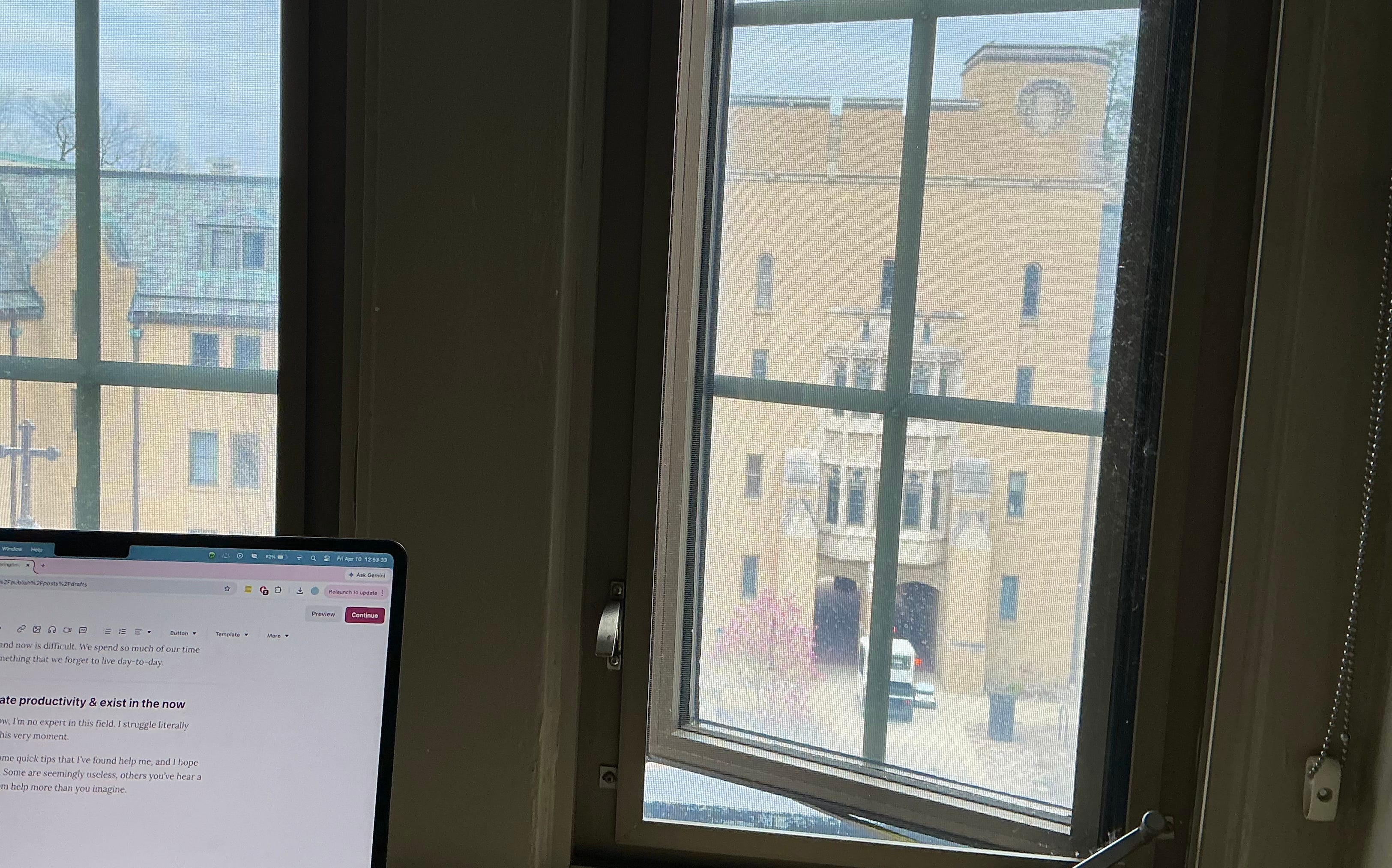
You may not be able to tell, but indoor air gets especially stale in the springtime. It’s hard to regulate heat versus AC usage, and things get weird and balmy. Opening the window, even just a crack, helps to bring freshness to the air you’re breathing.
Taking time to notice this new air with some deep breaths can help ground you in moments you haven’t even noticed you need grounding. If you’re feeling really bold, taking a long look outside can help you ground yourself, too. Notice the speed at which the clouds move, the breeze in the grass, the new buds of leaves on trees.
Beautiful things are constantly happening around you, even when you’ve been too stuck in your own head to see them.
I was going to write an entire article on how lovely opening windows makes me feel before I found myself sucked into this described depression-stagnation-procrastination spiral.
2. Move to a different spot
If you’re anything like me, you probably find yourself sitting in the same spot in your room all day. This tends to be my bed.
When I’m frozen in this singular spot and can’t find any motivation to move aside from twisting and turning in place, my depression gets infinitely worse.
It’s so comfortable where I’ve placed myself, but if I take time to notice it I can feel my legs need stretching and my back is aching. The solution to this is so simple it feels like a lack of solution: move to a different spot.
This isn’t to say leave the room or the house. It’s to say move from your bed to your couch, or from your couch to your desk, or from your desk to the floor.
Make any movement to somewhere different.

This tiny movement can have a big impact. It’s a means of being productive for solely yourself and changing your perspective.
Eventually, you’ll get so good at this minor movement that you’ll want to make it more dramatically impactful. This can look like moving to a different floor of the building, or moving to a different building entirely.
Your stagnant environment is actively holding your negative mentality in place.
3. Turn off your phone
This one is spouted all over the internet by everyone you’ve ever seen give a list of tips. But it’s for actual good reason.
I’m not a fan of the trending strategies of buying a totally new flip phone, or of actively powering off your device/moving it to another room. I need easy access in case of emergency, and a switch to a different device is impractical in our day and age.
So, I’ve spent a long time completely addicted to my phone without a real solution. Recently, though, I bought myself a Brick.

If you’ve never heard of this, it’s a tiny brick-like device that you have to physically tap to unlock your addicting apps. I’m a huge fan, though want to emphasize that I’m not sponsored by them in any way.
(Here’s a 10% off referral code, which does nothing for me but gets you a decent discount!)
Having a physical barrier from your phone, while still keeping access to any absolutely necessary apps, allows you to take back your time.
It’s genuinely demoralizing to stand up and “unbrick,” therefore motivating me to stay off my phone for a long time. I tend to have 10-13 hours a day completely offline thanks to this little guy.
If you can’t make the purchase, that’s okay! Consider downloading free apps like Opal that have screen time management functions.
Monitoring and limiting your screen time in any way is a must-do for stopping your cycles of procrastination and living wholly in the moment.
4. Make your own deadlines
While looming deadlines often cause me to procrastinate more, I find that creating my own deadlines can sometimes help.

For larger tasks like exams, projects, or personal goals, a good way to get things started is with self-chosen mini deadlines.
Write down somewhere that, for example, you need to write one chapter by 6 p.m. on April 15th. Then, promise someone you’ll show them your progress.
This system not only gives you a specific time to secure in your memory, but it keeps you accountable.
An example of what I do is promise you guys that I’ll deliver a new Normal Girl Field Guide episode every Friday. If I fail, I’m not just letting myself down, I’m also letting down my subscribers, no matter how few of you there may be.
With schoolwork, I still struggle with this tool. I’ll often lay out deadlines but then extend them because it’s not actually due yet. A way I’m trying to fix this is by staying in communication with my professors, and writing out specific times to work (with locations and a list ofexactly what I want to accomplish) on my Google Calendar.
Setting your own deadlines is an imperfect system, but one that greatly encourages progress nonetheless.
5. Find people
This next strategy goes hand in hand with the idea of accountability partners as was nestled in with the last tip:
Find someone to work with/alongside you.

This one requires some trial and error. Oftentimes, when sitting down to study with specific people you’ll find yourselves talking to each other more than working. Don’t repeatedly try something or someone that doesn’t work.
Instead, find another group to work with. Try people from your same course (or with similar goals) who you know well enough that you feel comfortable asking them, but not well enough that they’ll cause distraction.
Alternatively, find a room filled with people you don’t know. A busy library, a cafe, a crowded lawn, or some space that has people in it.
Then, sit down and do your work. It’s totally embarrassing to be seen leaving your books and laptop aside to scroll on your phone. It’s super cool and artsy, however, to be seen diligently typing away at something. This is one of my favorite methods of getting work done!
However you wish to do it, either with strangers or people you know, productivity often needs a supervisor. This isn’t a fault of yours, it’s just a way many people’s brains tend to function.
Grab a coffee and table and make sure prying eyes could drift to you at any moment. This sounds like a potential horror movie, but really you’re just channelling productivity in a great way.
Springtime sadness doesn’t mean you can’t enjoy the spring. For those who experience this phenomenon, it just means you might have to work harder to find that enjoyment.
I get annoyed that I seem to struggle during such a lovely time of year, while all my friends are bouncing back from their wintertime depression. It’s like I’m lagging behind in a race I didn’t know I was supposed to run.
But we have something no one else has.
We open our windows and notice every ounce of joy it brings us. We keep track of our shortcomings in order to highlight and grow our skills. We know expertly how our bodies best function at any time of year.
It takes more effort, but the outcome of knowing yourself so deeply is well worth that extra cost.
I don’t have my life together now, and I very well may not have it together ever, but I’m glad I get to sit here and write about my struggles. I’m grateful for the way I can spend half a day considering myself, and feel like I’ve grown by the end of it.
What can you be grateful for today?
P.S. I’m sorry if this article felt rushed in any way! As you can tell by the content, I was struggling with my own motivation and depression level while putting it together.

Rlly enjoyed this one! I’ve always said my depression gets worse in the summer which can be so frustrating but these tips are simple yet effective!! Opening a window always improves my mood.
Also studying abroad is so fun; I hope you write about your travels while you’re there!!
Loved this one. I totally feel you. The closer I get to finals the more I feel like I freeze. Stuck in time. I hope that you finish off the school year strong, and it's so exciting that you get to move to Ireland! Literally my dream